
Cash Flow Management is the process of tracking and optimising your cash flow in a given time period. Learn about the benefits and tips of Cash Flow Management now!
Poor cash flow management has been the downfall of many businesses so it can’t be left to chance. A regular supply of cash is vital to any organisation, so that it can pay salaries and bills, as well as invest in growth. This is why cash flow management is essential in order to have a thorough understanding of where your money is coming from and to project future revenue to secure company growth.
In this article, we provide guidance and answer your most-asked questions related to small business cash flow management: what is cash flow management, what are its benefits and what to do for a better cash flow management?
Let’s start by providing you with a definition of cash flow: it is the total amount of money that goes in and out of a business. Cash flows are classified into three categories as operating, investing, or financing activities on the statement of cash flows, depending on the nature of the transaction.
- Cash flow from operations (CFO) describes money flows from regular business operations, such as production and the sale of goods.
- Cash Flows from Investing (CFI) represents how much cash has been generated or spent from investment-related activities in a specific time period.
- Cash Flows from Financing (CFF) reports the net flow of cash that are used to fund the business and its working capital.
Cash flow management is the process of tracking and optimising your cash flow in a given time period. More concretely, it means analysing the money you receive – generated through sales for example – compared to the money you give out when you pay bills, salaries, taxes, etc.
Cash flow is different from profit, which is the sum of money remaining once all the costs associated to producing and delivering a product or service have been deducted.
When the difference between cash coming into and out of your business is negative at the end of a given period, it means you have less cash than the opening balance you had at the start of that period.
The objective of cash flow management is to avoid this by keeping track and optimising your cash flow, and to ensure that your cash inflows (cash receipts) are always higher than your cash outflows (cash expenses). The surplus can for example help you invest and grow, but there are many other benefits to sound small business cash flow management.
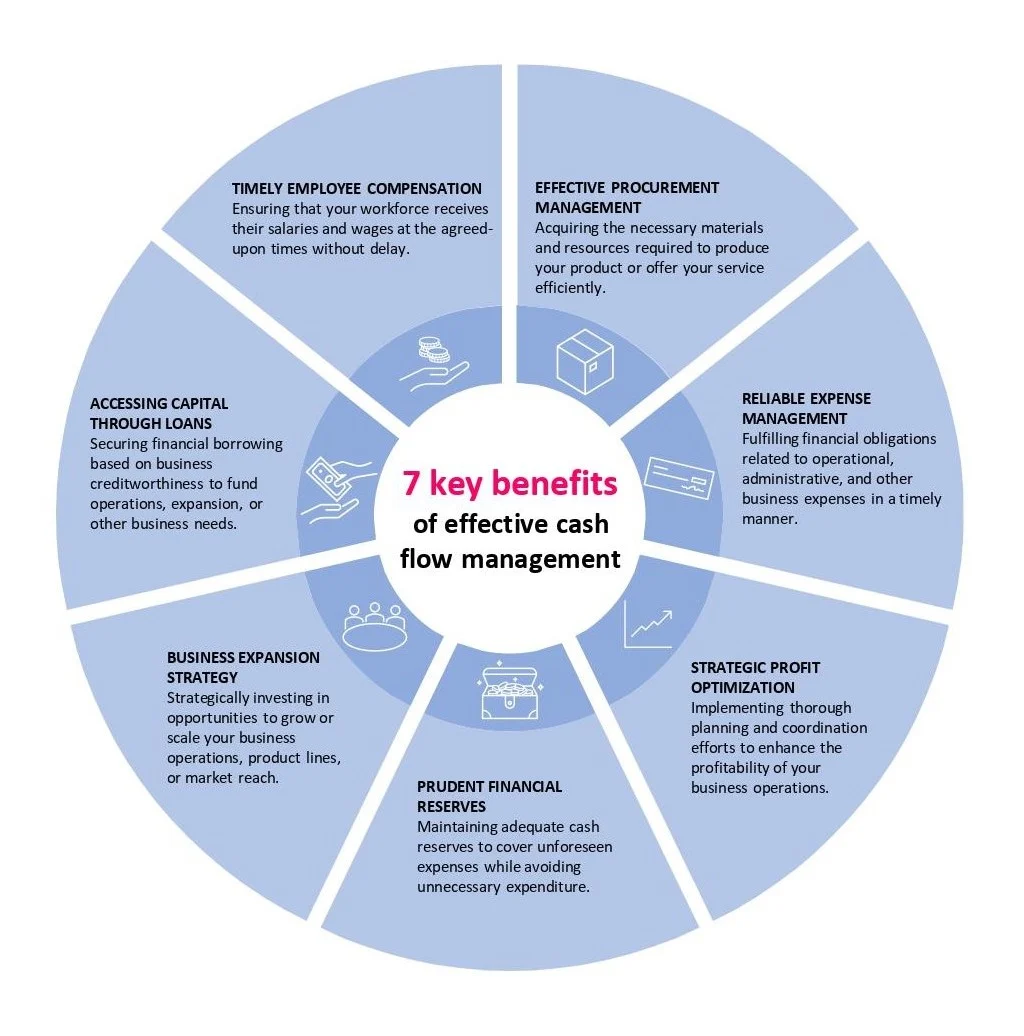
Here is a list of the top seven key benefits of cash flow management:
1 Paying your employees on time
Your staff helps you keep your business running, so paying them on time is essential. It’s a basic and fundamental element to retain their loyalty and attract talents. Thanks to solid cash flow management, you ensure you reserve cash for their salaries.
2 Purchasing what you need to create your product or deliver your service
Another of the multiple benefits of cash flow management is that it allows you to have a clear forecast of your account payables, which enables you to purchase the raw material or services you need to fulfil your orders. A potential surplus could also help you expand your product line.
3 Paying all your other expenses
Whether they are taxes, loan repayment or other bills, good cash flow management will allow you to keep track of all your past, current and future expenses, so that you can plan accordingly and ensure these expenses will be paid on time.
4 Planning and coordinating your activity to maximise profit
Planning is essential for any business and the lack of it may lead to disaster. One of the benefits of cash flow management is that it helps you plan, analyse performance and make a maximum available profit from your current activity. It will also enable you to prepare the financial budgets for the years to come.
5 eeping cash reserves and avoiding overspending
Without a sound cash flow management, you won’t monitor how much you spend and might overspend or use cash needed for something else. The analysis of your cash flow statement can help you determine whether the financial condition of your business is in a stable, excess or shortage state. Thanks to cash flow forecasts, you gain control, monitor your spending, determine your liquidity and profitability, and ensure you will have sufficient cash reserves in case of unexpected expenses or bad debts.
6 Expanding or growing your business
Another benefit of cash flow management is to allow your business to be opened to investments and growth opportunities. Indeed, thanks to your cash flow statement analysis, you are able to identify the ratio between your income and expenditure, which helps you assess the current financial position of your business and take budgeting decisions. For example, if you have a surplus, you can decide to develop new products or services, expand to a new market, etc.
7 Getting a business loan
Many businesses depend on banks or other financial institutions to finance some of their activities. In case of cash deficit, you might contact them for a loan to overcome the situation. Before granting you the loan, banks study the financial condition of your business and your ability to repay the amount. Thanks to cash flow management, you will be able to use your cash flow statements as proof and provide all the details regarding your cash inflows and outflows.
In summary, good small business cash flow management will grant you peace of mind by enabling you to ensure you can meet all your obligations, run your business more effectively and concentrate on your growth.
The Importance of a Cash Flow Forecast: Forecasting your cash flow is an essential practice that helps anticipate the financial position of your business in the future. A cash flow forecast provides a blueprint for managing incoming and outgoing funds, enabling you to plan for growth while avoiding financial pitfalls. By understanding your cash flow patterns, you can better manage payment terms with customers and suppliers, and make strategic decisions about when to invest in expansion or new opportunities. Implementing trade credit insurance can further enhance your forecast accuracy by protecting against unforeseen debtor insolvency, thereby ensuring your cash flow remains positive as planned.
To ensure you have a positive financial situation and avoid cash flow problems, here is some advice we recommend you to follow:
- Make cash flow forecasts regularly so that you can project your cash flow position – the income you’ll get (estimate your volume of sales, etc.) and how much money you’ll spend (forecast the expenses you’ll have to make, how much your will order, etc.) – and act on the conclusions.
- Research potential new customers thoroughly and analyse their creditworthiness by obtaining their financial rating, calling on local partners to gain insight or using alternative intelligence.
- Manage late invoices to avoid bad debts: follow credit control best practices for faster payment by invoicing your customers as soon as possible, setting up clear payment terms, as well as implementing a process to ensure your invoices will be paid on time and define what to do in case of unpaid invoices.
- Be alert to emerging threats, including debtors, any extra-large bills and loan repayment dates.
- Avoid overspending and ensure to make sound investments: before making a big investment or expanding your business, always consider what impact it will have on your cash and research the sectors or markets to fully understand the context.
- Keep cash reserves by saving a proportion of your cash to cover unexpected liabilities.
- Train your team to basic credit control principles (or hire people who know them) for a better cash flow management.
- Use a digital cash flow management software that can help keep track of invoices and expenditures, and provide a clear picture of your cash position.
Despite all the above, you might want to ensure your business is protected against credit risk by taking out a trade credit insurance policy. Trade credit insurance and export credit insurance help you secure your cash flow by covering your receivables due within 12 months, helping you to avoid bad debt and compensating you in case it happens. This is one of the best ways to complement your small business cash flow management.
Beyond managing and forecasting, optimizing your cash flow involves taking proactive steps to improve the efficiency of your cash inflows and outflows. This can include renegotiating supplier contracts, optimizing inventory levels, and improving invoicing processes to accelerate payments. Additionally, leveraging trade credit insurance can play a pivotal role in cash flow optimization by minimizing the risk of late or defaulted payments from customers. By securing your receivables, you can maintain a steady stream of cash, allowing for more aggressive growth strategies and investment in innovation.
想避免亏损? 立即了解贸易信用保险完善企业保险
贸易信用保险的保障范围
贸易信用保险能保障企业因未偿付的商业债务而蒙受损失,即企业对企业的应收账款。 假如买方因破产、无力清偿或其他因素导致您无法如期收到款项,贸易信用保险将会支付该笔未偿债务九成的金额,让您的资本和现金流得到保障,并在您为提升竞争力而放宽信用条件的同时确保收益,进而帮助您达成更优胜的企业融资方案。
在贸易信用保险的应收帐款保障下,贸易产生的商业及政治风险即使难以控制,您也能轻松对其进行管理。 此外,在您向目前既有的客户展延信用,或开发信用风险较高的潜在大宗客户时,购买贸易信用保险也能让您感到安心。
贸易信用保险如何为您避免亏损
客户财务健康状况
我们会针对您客户的信誉及财务稳健度进行分析。
计算信用额度
我们会针对每位客户计算其对应的信用额度; 当某客户无力清偿时,此额度将是安联贸易理赔金额的最高上限。
照常运作
在风险的保障范围内,您能按照业务意愿持续与现有客户进行贸易。
更新贸易限额
我们会在情势变动导致贸易限额出现涨跌时,向您汇报限额发生的任何调整。
业务拓展
您可通过安联贸易来检查潜在新客户的信誉,而我们不仅会确认您的合作协议,在我们无法提供服务时也会说明其原因。
申请理赔
一旦客户出现无力偿还的情况时,您应向我们提供完整的相关信息。 在深入调查并确认符合保单条款后,我们会向您支付理赔金。
You might also be interested in...