The Asia-Pacific region is the world's largest and fastest-growing market for chemicals, and global shifts are reshaping its future. Rapid industrialization, urbanization, and increasing consumer spending in countries like China and India are creating robust demand. At the same time, the sector faces a twin challenge: optimizing operations to counter global oversupply and adapting to the growing necessity of environmental sustainability. This guide highlights the key trends driving growth, investment, and transformation in the APAC chemicals sector in 2025.
Summary
Key takeaways
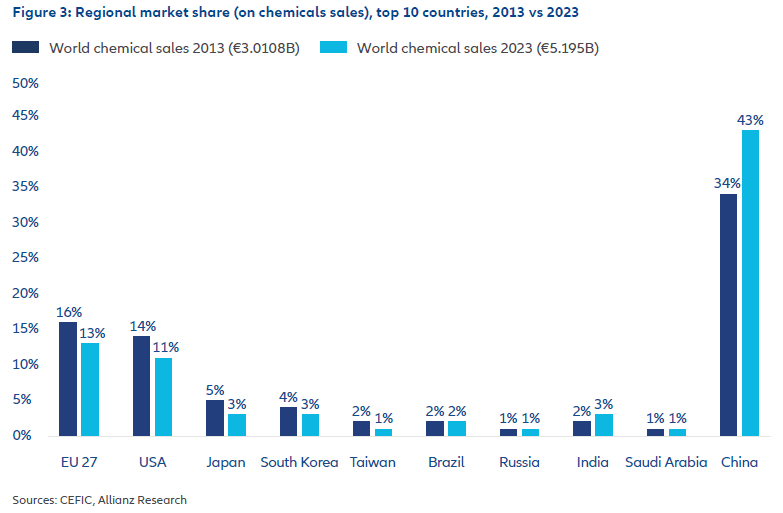
- Market Dominance: China holds a 43% market share in global chemical sales, up from 34% a decade ago.
- Sustainability Push: Regulatory pressures are driving the adoption of green chemistry and circular economy initiatives across the region.
- Supply Shift: Geopolitical risks are accelerating the focus on regionalization, positioning countries like Vietnam, Malaysia, and Indonesia as key alternative manufacturing hubs.
China remains the undisputed dominant force in the global chemicals market, both as a producer and consumer. Its market share in global chemicals sales reached 43% in 2023, a significant expansion from 34% a decade prior. This dominance is fueled by a vast domestic market and ongoing infrastructure and industrial expansion. Meanwhile, India is expected to emerge as a key growth market, driven by its large population, growing middle class, and strong government support for infrastructure and manufacturing. This dual engine of growth, though facing geopolitical risks, is expected to maintain the sector's forward momentum.
Environmental sustainability is no longer optional; it’s a growing focus driven by regulatory pressures across APAC. This push is encouraging the adoption of green chemistry, biodegradable products, and renewable chemicals. For companies, embracing sustainability—such as developing bioplastics or bio-based solvents—is fast becoming a competitive advantage and a necessity to secure market share. Countries are also actively promoting circular economy initiatives that prioritize recycling and waste reduction. Singapore, for instance, is positioning itself as a leader in this space with major projects aimed at developing sustainable biomanufacturing technology.
Following the vulnerabilities exposed by the Covid-19 pandemic and the impact of geopolitical tensions, including the US-China trade dispute, the chemicals sector is facing continuous pressure to diversify supply chains. This has led to a focus on regionalization, with countries in Southeast Asia, such as Vietnam, Malaysia, and Indonesia, gaining prominence as alternative manufacturing hubs. This structural shift aims to create a more balanced global supply network, reducing the risks associated with over-reliance on specific manufacturing locations.
Explore key 2025 trends in the Asia-Pacific chemicals sector, from industrial growth and sustainability to diversified supply chains shaped by post-COVID and geopolitical shifts.
The APAC chemicals sector in 2025 is defined by powerful, yet contradictory, forces: robust growth in emerging markets and increasing pressure from geopolitical risk and the need for sustainability. Navigating these shifts requires strategic investment, particularly in R&D and digital tools, to maintain a competitive edge and secure trade flows.
Ready to gain comprehensive market intelligence on the APAC chemicals sector?Download your copy of the Shaping The Future of Chemicals in APAC report today to map out your strategy!
You might also be interested in...