
Extending credit to customers is a necessary part of doing business, but it comes with the inherent risk that some invoices will never be paid. When an account receivable becomes uncollectible, it becomes a bad debt, and it must be accounted for on your income statement as a bad debt expense. This expense directly reduces your profitability and impacts your cash flow. Effectively managing and protecting your business against bad debt expense is therefore crucial for your financial health. This guide covers how to account for, manage, and ultimately, insure against this critical business cost.
Summary
Key takeaways
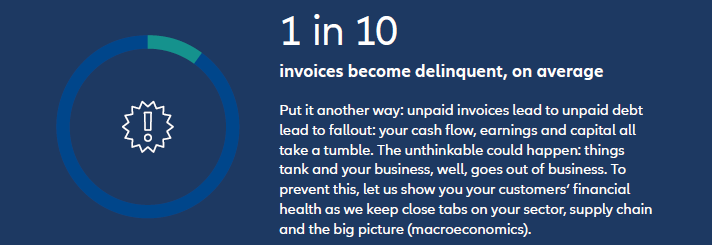
Unspoken risk: Unpaid invoices are a major threat, with 1 in 10 invoices becoming delinquent on average.
Prevention is key: Strong internal credit management policies are the first line of defense against bad debts.
TCI as a strategic solution: Trade Credit Insurance is a powerful tool to transfer the risk, protecting your P&L from unexpected spikes in bad debt expense and making it a predictable, manageable cost.
Beyond protection: TCI helps you increase sales by up to 20% on average and allows you to expand into new markets with confidence.
- Bad debt is a receivable that is no longer deemed recoverable because the customer is unable or unwilling to pay. This can happen for many reasons:
- Customer Insolvency or Bankruptcy: The most common reason.
- Severe Cash Flow Problems: Your customer's own clients may be paying them late.
- Disputes or Fraud: Disagreements over the goods/service or deliberate credit fraud.
- Market Downturns: A sudden economic shift can impact a previously healthy customer.
The first warning sign of a potential bad debt is a late payment. Proactive management at this stage is critical.
Companies naturally focus on maximizing profits, but they often overlook how to prevent bad debts. More than 35% of a company's assets are accounts receivable, and on average, 1 in 10 invoices becomes delinquent. Unpaid invoices can lead to a tumble in your cash flow, earnings, and capital. For many businesses, it can even lead to insolvency.
While some bad debt is inevitable, you can take internal measures to minimize it:
- Proactive Credit Management: Implement sound credit control policies. This includes conducting thorough credit checks on new customers, setting appropriate credit limits, and having clear, enforceable payment terms in your contracts.
- The Collections Process: When an invoice becomes overdue, act quickly. Maintain professionalism, as the goal is to collect the debt while, if possible, maintaining the customer relationship.
Internal controls can reduce risk, but they cannot eliminate it. A large, unexpected customer failure can create a significant spike in bad debt expense, severely damaging your profitability.
Bad debt insurance—also known as non-payment insurance or Trade Credit Insurance (TCI)—is the most effective way to transfer this risk. Instead of facing unpredictable and potentially catastrophic bad debt losses, TCI converts that risk into a predictable, budgeted premium.
- Protection: If an insured customer fails to pay due to insolvency, your TCI policy compensates your company, typically for up to 90% of the debt. This directly protects your P&L and cash flow.
- Prevention: Trade Credit Insurance from Allianz Trade is more than just a safety net. We arm you with what you need to know to avoid bad debts in the first place. Our proprietary intelligence network analyses daily changes in over 80 million corporates' solvency.
- Recovery: Our global network of debt collection experts operates in 170 countries to help recover outstanding payments professionally, often preserving the customer relationship.
Bad debt expense is a direct hit to your company's bottom line. A comprehensive strategy to manage it involves a multi-pronged approach: accurate accounting, proactive internal credit management, and strategic risk transfer. By combining sound internal controls with the robust protection of bad debt insurance, you can turn a volatile financial risk into a manageable and predictable business cost, giving you the confidence to trade and grow securely.
You might also be interested in...